
LVP, Tile or Epoxy: The Best Flooring for a North Dakota Basement

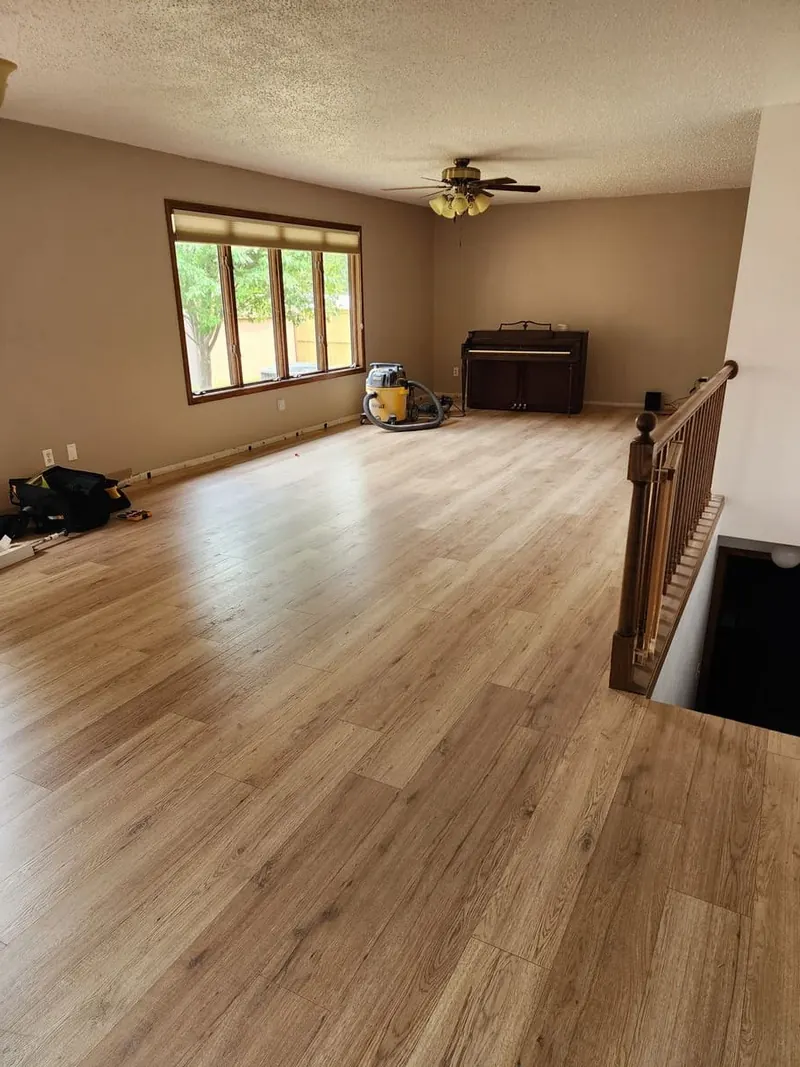
Who this is for: homeowners finishing a basement or replacing a floor over concrete in Bismarck-Mandan who want a floor that handles moisture and a cold slab.
The short answer
For most basement living space, luxury vinyl plank (LVP), including rigid-core versions often sold as SPC, is the best default: it shrugs off occasional moisture, it's comfortable enough for family rooms and bedrooms, and damaged planks can be replaced. Use porcelain tile in basement bathrooms, laundry rooms and wet bars, and an epoxy coating in utility rooms, workshops and garages. Whatever you pick, test the concrete slab for moisture before you choose, because the slab decides what will last.
Basement flooring compared
A basement floor sits directly on concrete that is in contact with the ground. That means two things every option has to handle: moisture coming up through the slab, and a slab that stays cool most of the year. Here's how the five common choices compare.
| Floor | Moisture tolerance | Feel on a cold slab | Repairs | Best for |
|---|---|---|---|---|
| LVP / rigid-core vinyl | High at the surface; water from below or at the seams can still cause problems | Cool, warmer with an approved underlayment | Damaged planks can be replaced | Family rooms, bedrooms, offices |
| Porcelain tile | Very high; water doesn't hurt the tile | Coldest and hardest | Single cracked tiles can be replaced | Bathrooms, laundry, wet bars |
| Carpet tile | Low to moderate; wet tiles can be pulled up and dried or swapped | Warmest and softest | Swap individual tiles | Playrooms, home gyms in a dry basement |
| Engineered wood | Moderate; needs a moisture-tested slab and a vapor retarder | Warmer than tile or vinyl | Harder to repair | Dry basements where you want real wood |
| Epoxy coating | High once cured, if the slab is prepared and dry enough | Cold and hard | Can be patched or recoated | Utility rooms, workshops, garages |
In two larger 2026 HHI proposals, laying LVP was priced at $3.00 or $3.50 per square foot for installation, and one basement budget carried a separate $3.50 per square foot for the planks. Stairs, removing an old floor and slab repair are priced on their own lines. We install LVP, laminate, tile and epoxy coatings over a suitable slab, and our page on flooring installation in Bismarck-Mandan covers each one. Below grade, solid hardwood is a poor fit. Vinyl plank is what our recent basement estimates used, and tile, epoxy and engineered wood are options for a dry slab.
Test the slab before you choose
Moisture in the slab is the most common reason basement floors fail, so it gets checked before anything else. The EPA notes that concrete slabs, especially those without insulation underneath, are often colder than the air in the basement (EPA, Remodeling Your Home and Indoor Air Quality). Cold concrete and humid summer air are how condensation forms under a floor.
Flooring installers use measured tests, not a hand on the concrete. One commonly specified method is the ASTM F2170 relative humidity test, which places probes inside the slab at a set depth to predict how much moisture the floor will see (Hardwood Floors magazine, National Wood Flooring Association). Whatever floor you choose, the slab should be tested before it goes down.
Flatness matters as much as moisture. A floor that feels uneven or bouncy usually has a subfloor problem underneath: low spots, weak areas or old water damage. We inspect and fix the base first so the new floor performs the way it should. If the basement itself has a history of water, start with our moisture checks before you finish.
Replacing a floor that got wet works the same way. The new floor goes down after the source of the water is fixed, the base is checked, and the slab meets the conditions of the flooring you choose; drying isn't set by the calendar. If a leak or flooding has already damaged the floor, start with our page on basement water damage repair.
LVP: the default for basement living space
Many homeowners choose LVP for durability and easy upkeep, which makes it the natural starting point for basement family rooms and bedrooms. The planks themselves resist water, so a spilled drink or a wet boot won't hurt them.
The word "waterproof" on the box needs a footnote, though. Water that comes up from the slab, or that gets under the floor at the seams and edges during a leak, can still lead to mold or damage underneath. That's why the slab test and the manufacturer's below-grade installation rules matter: they set the moisture limits and the underlayment you can use.
On a North Dakota slab, vinyl feels cool in winter. An underlayment approved by the flooring manufacturer adds some warmth and quiet. For a truly warm floor, electric heat under tile, such as Schluter DITRA-HEAT, is a common choice; if you want one, we review the product and the slab before pricing it.
Vinyl plank in a North Dakota winter: gaps, peaking and how to avoid them
Vinyl plank moves with temperature, so a floor that's installed cold, left without room at the edges, or pinned in place can open gaps or lift at the seams. Forbo, a resilient flooring maker, explains that vinyl is susceptible to temperature changes, and that a floating floor with no perimeter gap can buckle or peak where it meets a wall. North Dakota adds two twists: planks that arrive from a freezing truck or garage, and months of dry, heated indoor air.
Acclimation: let the planks reach room temperature
The rules differ by product, so the install guide in the box wins. Shaw's guide for one rigid-core (SPC) line says acclimation isn't required. MSI's rigid-core guide also skips it under normal conditions, but if the flooring has been below 40°F or above 95°F, it calls for at least 12 hours in the room, cartons spread out. Karndean's rigid-core guide says residential jobs usually don't need it within 65–85°F, but do after exposure to extreme temperatures. A delivery in a Bismarck January counts as extreme, so let the planks warm up in the room where they'll go.
Expansion gaps, and what pins a floor in place
A floating vinyl floor needs room to move at every wall and fixed object, hidden under the baseboard or quarter-round. The size depends on the product: Karndean's minimum is 3/16 inch, Shaw's is 1/4 inch for floors under 2,500 square feet, and MSI's is 3/8 inch. Peaking usually means something is keeping the floor from moving:
- Trim fastened through the planks. The guides say baseboard, quarter-round and transitions attach to the wall or subfloor, not to the floating floor.
- Cabinets or an island set on top. MSI says not to set fixed objects like cabinets on a floating floor unless it's fully adhered; Shaw requires full adhesion under them.
- Long runs with no break. MSI and Karndean both call for a transition or expansion joint where a run goes past 50 feet.
- Tight spots. Pipes, posts and metal door jambs need the same gap as the walls; wood jambs are usually undercut so the floor slides under them.
Leave the expansion gap the flooring's install guide calls for, fasten trim to the wall instead of the floor, and don't set cabinets on top of a floating floor.
Keep the heat on, and watch the sun
Most guides set a temperature range for the life of the floor, not just install day: 65–85°F for Karndean, 65–78°F for MSI, and 55–85°F for the Shaw line in a climate-controlled home. Turning the basement heat way down while you're away for the winter can take the floor out of that range. Some floating products are rated for unheated spaces (that Shaw line lists -25°F to 155°F after installation), so check before you put vinyl in a cabin or three-season porch. Sun through a patio door or a large egress window can overheat planks too; MSI recommends blinds or drapes during peak sun.
Indoor humidity in winter
Vinyl responds more to temperature than to humidity, but some manufacturers still set a humidity range: MSI's is 35–70% during installation and for the life of the floor. NDSU Extension suggests aiming for about 40% in winter and notes that at that level, double-pane windows start to show condensation once it's below zero outside. A setting in the 35–40% range meets that flooring minimum and stays near NDSU's target; if windows fog on the coldest nights, turn it down a little.
If a few small gaps show up mid-winter, Shaw notes that slight gaps can be tapped closed with a tapping block. Gaps that keep reopening, or seams that peak, are worth a call: check that nothing is pinning the floor and that the room stays within the manufacturer's range.
Tile: bathrooms, laundry and wet bars
For wet areas, tile is the right long-term choice. Porcelain isn't affected by water, holds up to heavy use and is easy to clean, which makes it the right floor for a basement bathroom, laundry room or wet bar.
The trade-off is comfort: tile on concrete is the coldest, hardest floor on this list. Cracks in the slab also need attention before tile goes down, because movement in the concrete can crack the tile above it.
Epoxy: utility rooms, workshops and garages
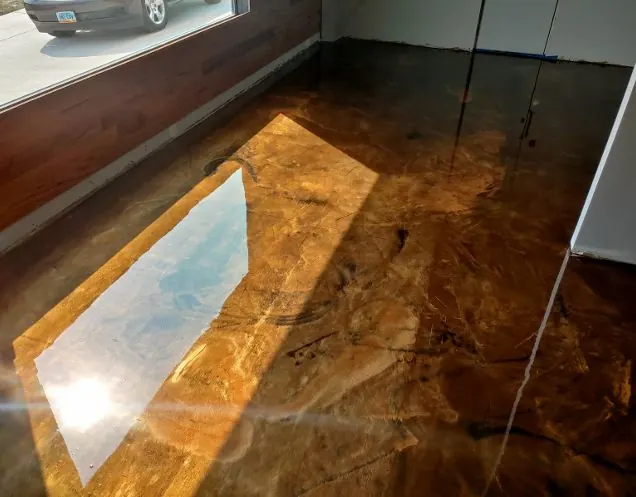
Epoxy bonds to the concrete itself, so there are no seams for water to get under. That makes it a strong choice for utility rooms, storage, workshops and the garage. Finishes range from solid colors to decorative flake and metallic looks. See our epoxy floor coatings for examples. If the floor you're thinking about is in the garage, our comparison of epoxy vs. polyaspartic garage floors covers road salt, hot tires and winter installs.
Epoxy is only as good as the slab under it. Standard prep is part of the job; major concrete repairs or moisture mitigation are priced separately when a slab needs them. It's also hard and cool underfoot, so in a basement family room most people prefer LVP.
What to avoid below grade
- Solid hardwood. The American Hardwood Information Center warns that moisture can cause problems for solid wood floors below ground level and points to engineered wood as the better choice there. Hardwood Floors magazine, published by the National Wood Flooring Association, recommends only engineered wood over below-grade concrete slabs.
- Wall-to-wall carpet where water has been a problem. The EPA advises against carpet near water sources or in areas with chronic moisture. In a dry basement, carpet tile is a safer way to get a soft floor.
- Standard laminate with a wood-fiber core in damp spots. If water reaches the core, it can swell, and swollen boards don't go back.
Cost and install time
Here are real numbers from 2026 HHI estimates, each with the work it paid for:
- LVP on a larger job: 1,540 sq ft of straight-lay installation came to $5,390 in labor, with the homeowner supplying the planks. Carpet removal, baseboards and stairs were priced separately.
- Customer-supplied laminate: about 450 sq ft was estimated at $1,800–$2,000 for installation and putting the reusable trim back, with no demolition or prep included.
- Vinyl over old ceramic tile: 1,200 sq ft in Bismarck came to $6,550: $4,000 for installation and $2,550 for a preparation package that included priming, sealing and self-leveling up to 800 sq ft.
- Stairs: standard LVP steps were $175 each and larger steps $300 each in one proposal.
The price depends on square footage, prep work like leveling or subfloor repair, the material, and trim and transition details. Tile floors and epoxy are priced after we see the slab.
If you're looking for the least expensive way to finish a basement floor, sealing or staining the existing concrete or a basic vinyl plank is usually the least expensive, tile and engineered wood cost more, and epoxy depends heavily on how much slab prep is needed. The cheapest floor, though, is the one you don't have to replace after the first wet spring, so let the slab test guide the choice.
Planning the whole basement?
If the floor is part of a bigger project, it's worth planning it together with the walls, insulation and moisture work, so the floor isn't the last-minute decision. We handle full basement finishing, from framing to flooring.
Frequently asked questions
Is tile or LVP better for a basement?
For most basement living space, LVP is the better fit: it resists water, feels warmer and softer than tile, and planks can be replaced. Tile is better in wet areas like bathrooms, laundry rooms and wet bars, because water doesn't affect it at all. Many basements use both: LVP in living areas and tile where water is expected.
What type of flooring is best for a basement with moisture?
First, find out how much moisture and where it comes from, because no floor fixes a wet slab. If the slab tests within the manufacturer's limits, tile, epoxy and LVP handle damp conditions best. Avoid solid hardwood, wall-to-wall carpet and wood-fiber laminate. If water is coming in, fix the cause before you choose a floor.
What is the best flooring to lay over concrete?
Over a dry, flat slab, LVP is the most practical choice for living space, porcelain tile for wet rooms, and epoxy where you want the concrete itself as the floor. Engineered wood can work over concrete when the slab passes moisture testing and a vapor retarder goes down first. Solid hardwood is not recommended below grade.
Why is my vinyl plank floor separating in the winter?
Vinyl shrinks a little when it gets cold, so gaps can open if the room drops below the manufacturer's temperature range, if the planks were installed before they warmed up, or if the locking edges are damaged. Peaking at seams usually means the floor can't move: trim nailed through it, cabinets on top, or no expansion gap. Keep the room within the range in the install guide, and if gaps keep coming back, have the installer check what's pinning the floor.
Can you install new flooring over an existing floor?
Sometimes. It depends on how flat the old floor is, the moisture risk, how the new height meets doors and other rooms, and the flooring manufacturer's requirements. In a basement, taking the old floor up also lets us check the slab underneath. We'll recommend the approach that will hold up longest.
Not sure which floor fits your basement? We look at the slab before choosing the floor. For a family room we can compare vinyl plank and other suitable finishes; in a wet room, tell us where water collects and how the floor will be used. Call or text Viktor at (701) 329-9659 with your town, photos and what you want to change. Our office follows up during business hours. You can also request a free written estimate through the form below. HHI is licensed in North Dakota (contractor license No. 000050538, Class D), and our employees are covered through WSI.
Planning a flooring in Bismarck–Mandan?
Free in-home consultation and a written estimate before any work starts.

Not ready to talk yet? Browse our catalog first.
Showers, bathrooms, basements, kitchens and floors we build, with the options and materials explained in plain English. We send it to your inbox. No calls.
Get your free estimate
Takes about a minute. Our office follows up during business hours; Viktor confirms the visit and the written scope.

Viktor, your general contractor, coordinates your estimate
- Our office follows up during business hours
- Free in-home consultation in Bismarck–Mandan
- Written estimate before any work starts